Petrification
The King in YellowPetrification is the central material phenomenon produced by Boris Yvain’s solution: an immersed living or organic form is attacked so violently that, in a second, it becomes a stone duplicate. The process gives matter an uncanny beauty—marble marked with blue veins, rose-colored depths, and opalescent light—but its aesthetic perfection conceals a lethal transformation. Through successive experiments on a lily, a fish, a rabbit, and finally Geneviève, petrification turns the boundary between life and sculpture into the story’s most unstable reality.
Discovery and Operation
Boris Yvain arrives at petrification through an investigation of natural mineral processes. The narrator understands only that silica can replace vegetable matter atom by atom, producing stone copies of leaves and twigs, whereas Boris has discovered a solution that performs in a second what mineral springs accomplish over years. The solution attacks its object with extraordinary ferocity, and Boris associates the reaction with a new element precipitated in metallic scales. Its simplicity frightens him precisely because its consequences are so immense: scientists would be fascinated, but the discovery could escape the studio and alter the wider world.
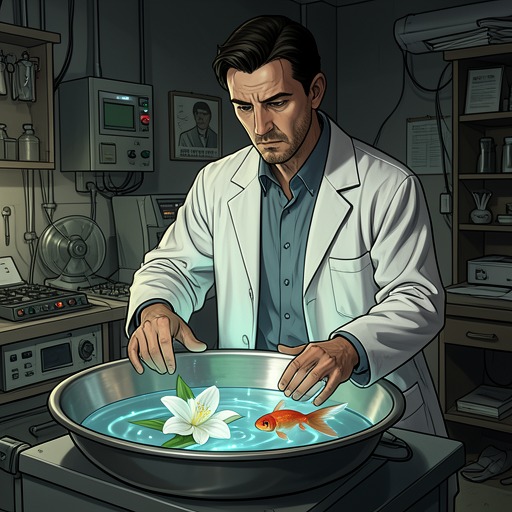
The transformation has a recognizable visual sequence. Boris drops an Easter lily brought by Geneviève from Notre Dame into the basin. The liquid immediately loses its crystalline clarity; milk-white foam envelops the flower, orange and crimson tints move across the surface, and a shaft of pure sunlight-like radiance rises from beneath the submerged object. Boris identifies that golden ray as the moment when it is safe to withdraw the specimen. The lily emerges as flawless marble, white as snow but carrying pale azure veins and a faint flush within its heart.
The same pattern appears in the goldfish Boris has already tested. Its marble body is veined with blue, while a rosy interior glow resembles the tint sleeping inside an opal. The visual beauty is not incidental decoration: it makes the converted object difficult to regard simply as a corpse or specimen. Petrification preserves form with extraordinary exactness while replacing living substance with a cold, luminous permanence.
From Artistic Experiment to Death
Boris initially treats petrification as a problem belonging to art. He fears that the discovery would corrupt the world of art and declares that he will not confide the secret to anyone. The danger lies not only in its capacity to kill but in its ability to make perfect sculpture without the sculptor’s labor. The resulting marble flower reproduces the delicacy of a natural object more convincingly than an artist could reproduce it, challenging the distinction between imitation and creation.
The experiment becomes darker when Boris, troubled by Geneviève’s illness, calls the pink-sided basin his bath full of death. He removes another goldfish from its globe and places it in the liquid. The creature twists angrily as its scales flash orange; on contact with the solution it becomes rigid, sinks to the bottom, and is recovered as an exquisite marble form, blue-veined, rose-tinted, and covered with opalescent drops. Boris calls the act child’s play, but the narrator experiences the scene as the extinguishing of warm life rather than as a harmless demonstration.
Jack Scott then insists on extending the experiment to a white rabbit. The narrator refuses to watch the animal die and withdraws to read, but Boris and Jack return carrying the marble rabbit. The juxtaposition is crucial: the transformed rabbit is evidence of successful technique, yet its presence converts the studio into a place where ordinary domestic and artistic objects can suddenly become remains. Petrification therefore shifts from controlled experiment to a force that reorganizes the moral atmosphere of the house.
Geneviève and the Marble Room
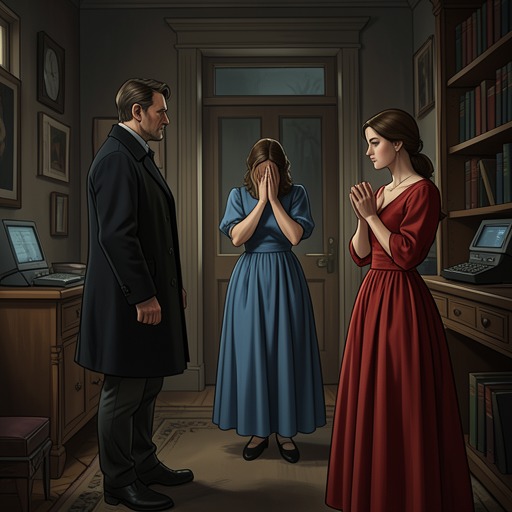
Petrification becomes inseparable from Geneviève after her fever reveals that she loves the narrator. Her confession changes the relationship among the three companions, and the narrator’s life is redirected by the disclosure. Later, after returning to Boris’s house in Paris, he can paint there tranquilly but avoids the marble room where Geneviève lies. The room becomes both a forbidden chamber and the material center of his grief: he longs to see her face and kneel beside her, yet cannot enter.
Two years after an earlier dream, the narrator is drawn toward the sealed door by memories of Geneviève and by the objects associated with her. The wolf-skin, old helmets, Spanish morion, and spinet make the house a repository of recollection before the door opens. Inside, sunlight falls upon the Madonna and the marble figure beneath it. Geneviève’s body has the same characteristic signs as the lily and fish: pale azure veins show through her white arms, while the folds of her dress carry a rose tint as if a faint warmth still burns within her breast. Petrification appears to have made her permanently beautiful, but it has also made mourning physically touchable. The narrator kisses the marble drapery and retreats, treating the transformed body as both sacred image and lost beloved.
Reversal and Recognition
The apparent finality of petrification is unsettled by the house’s later disturbances. A maid reports that the marble rabbit has disappeared and that a live rabbit has been brought into the house. The two beautiful marble fish are also gone, replaced by ordinary living fish found flopping on the dining-room floor. In the studio, the narrator finds that only the marble Easter lily remains. When he lifts it, however, the object is no longer stone: it is fresh and fragile, and its perfume fills the room.
This reversal transforms the meaning of every earlier experiment. What seemed to be irreversible substitution may instead have been a temporary state, or a state whose limits the observers misunderstood. The material evidence itself becomes unreliable: marble objects vanish, living substitutes appear, and the lily changes under the narrator’s hands. The solution’s power is therefore not merely destructive. It produces an unstable passage between organic life and mineral form, making recognition depend on touch, scent, and immediate bodily perception rather than on memory or testimony.
The narrator suddenly understands the implication and rushes to the marble room. The doors open, sunlight streams toward him, and the Madonna appears to smile as Geneviève lifts her flushed face from the marble couch and opens her sleepy eyes. Her return is presented through the same visual vocabulary that had marked petrification—marble, light, color, and the sacred Madonna—yet the decisive sign is movement and awakened consciousness. Petrification has thus carried the narrative from life to apparent death and back to life, converting a scientific marvel into a reversal structured around love and recognition.
Material Agency and Narrative Significance
Petrification repeatedly acts upon the plot rather than remaining a passive invention. It changes flowers and animals into objects, alters the moral character of Boris’s studio, gives physical form to Geneviève’s deathlike absence, and finally destabilizes the distinction between absence and recovery. Human intentions remain important—Boris investigates, tests, conceals, and repeats the process—but the liquid’s colors, foam, ray of light, and unpredictable reversals impose their own sequence upon events.
The phenomenon also joins scientific curiosity to artistic desire. Boris sees a new element and a threat to the world of art; the narrator sees beauty but recoils from the destruction required to produce it. The marble lily is simultaneously specimen, sculpture, relic, and test of perception. Geneviève’s transformed body intensifies that ambiguity: it resembles a statue beneath the Madonna, yet its veins and rose-colored depths preserve the suggestion of inward life.
As a state, petrification is defined by contradiction. It promises flawless preservation while seeming to enact death; it removes organic substance while retaining recognizable form; it creates permanence but ultimately proves reversible. Its most decisive consequence is therefore epistemological as well as physical. The characters cannot securely know whether they are looking at a dead object, a living being, or a phase between the two. By making matter beautiful, lethal, and potentially restorative, petrification gives the story its governing image of love struggling against the apparent finality of loss.